Agent-Ready SaaS: Building Software Other People's Agents Can Use
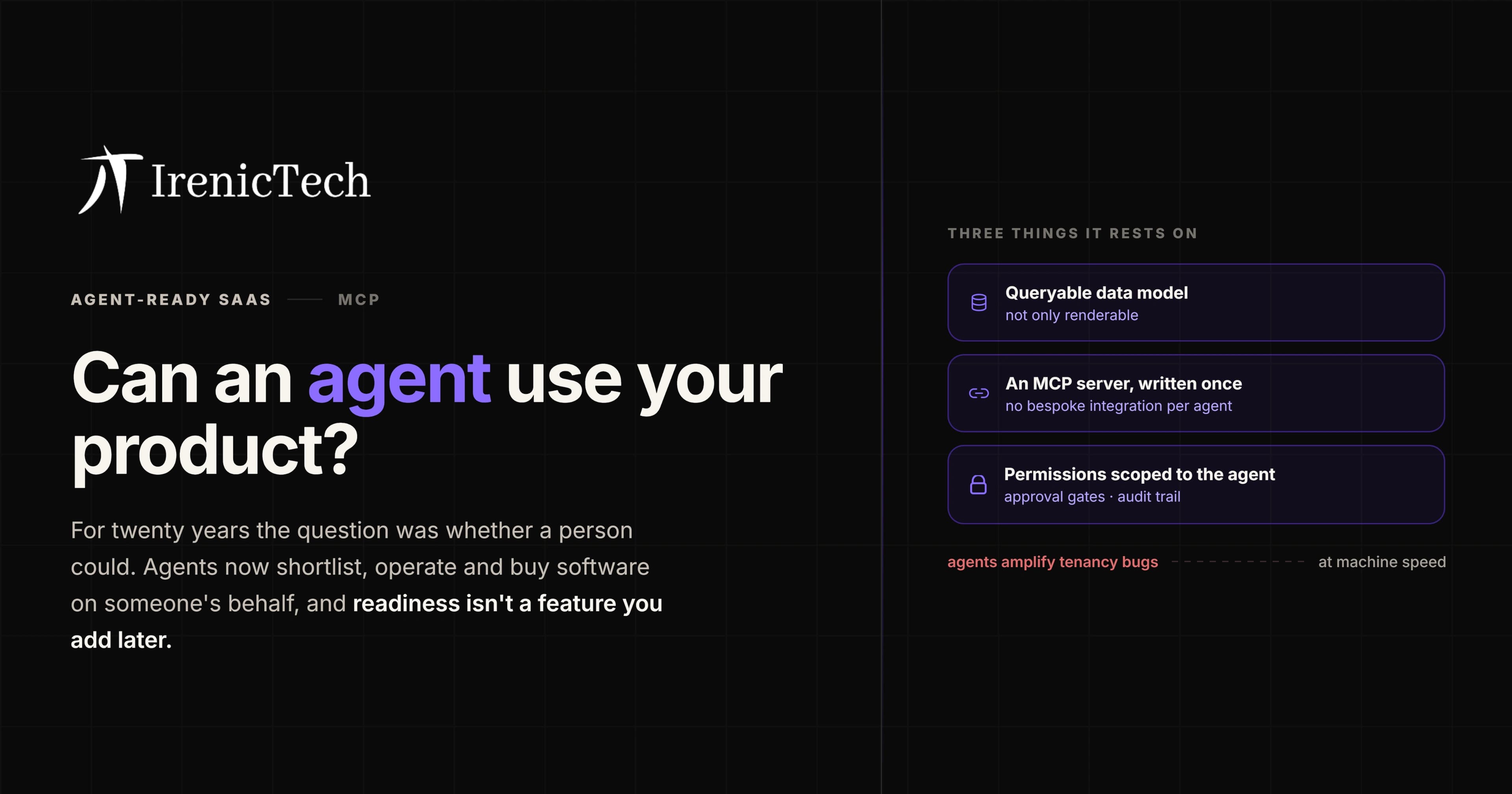
For twenty years the question was whether a person could use your product. The new question is whether an agent can, because agents now shortlist, evaluate, operate and increasingly buy software on someone's behalf. Agent-readiness is not a feature you add later; it is a property of your data model, your API and your permission system. This is what it actually requires.
IrenicTech · · 8 min read
For about twenty years the question was whether a person could use your product. Could they find the feature, understand the pricing, complete the task.
That question has not gone away, but a second one has arrived beside it, and it is increasingly the one that decides whether you are in the conversation at all: can an agent use your product?
Not in a futuristic sense. Agents already shortlist tools by reading documentation, evaluate them by calling APIs, operate them on a customer's behalf, and in some categories complete purchases. If an agent cannot determine what your product does or cannot drive it, you are not competing badly. You are absent.
This guide covers what agent-readiness actually requires, in the order it usually has to be built.
It is mostly a data problem
The instinct is to treat this as an integration project. It is mostly a modelling project.
An agent can only recommend, operate or buy what it can query. Most software catalogues, product records and account structures were built to be rendered to a human: fields that are complete enough to look right on a page, statuses that make sense next to a label, prices that are correct in context. Rendering tolerates ambiguity because a person resolves it. Querying does not.
The practical test is uncomfortable and quick. Pick a question a customer's agent would reasonably ask about your product, something like which of these plans supports this specific capability at this seat count. Then ask whether that is answerable from structured data you expose, or whether it is answerable only by a person reading three pages and inferring.
If it is the second, no protocol work will help you, because the protocol will faithfully expose data that cannot answer the question.
This is why the structured-data work is the low-regret starting move. It improves ordinary search visibility, feed quality, AI-assistant surfacing and your own analytics, whether or not an agent ever drives your product directly.
The clearest live example of the whole pattern is commerce, where agents now discover, pay and authorise across several open protocols, and where the merchant-side requirement turns out to be precisely structured product data rather than anything exotic. We covered it in AI agents are buying things now.
How an agent decides you exist
Before anything drives your product, something has to decide your product is worth considering. That step happens earlier than most vendors realise, and it is not controlled by your marketing site.
When a person asks an assistant to recommend a tool, or when an agent is choosing which service to call for a task, the material it reasons over is whatever is publicly legible: your documentation, your changelog, your pricing page, your schema markup, third-party write-ups, and increasingly a machine-readable summary of your site. What it cannot parse, it cannot weigh.
Three things move this more than anything else.
Documentation is now a sales surface. Not in the loose sense that good docs help buyers. In the literal sense that an agent evaluating options reads your docs and a competitor's, and forms a view. Docs that describe capabilities precisely, state limits honestly and give real examples get represented accurately. Docs that are thin, marketing-toned or out of date get represented as thin, and the agent moves on without anyone ever seeing a bounce.
Structured data decides whether you can be compared. Schema markup on pricing, features and availability is what lets a machine place you next to alternatives on a specific attribute rather than only on a general impression. A product that cannot be compared on the attribute a buyer cares about tends not to be shortlisted on it either.
A machine-readable summary is cheap and underused. A plain-text description of what your site contains and where the important pages are costs an afternoon and makes every subsequent step easier for anything crawling you. We publish one for this site for exactly that reason.
None of this replaces the data and permission work below. It is the precondition for it. An immaculate MCP server on a product no agent ever selects is an integration nobody calls.
The general mechanics of being surfaced and cited by AI systems are covered in GEO and AEO in 2026, and the question of whether it is actually working for you in measuring AI search visibility.
The integration layer is MCP
Once the data can answer questions, something has to expose it.
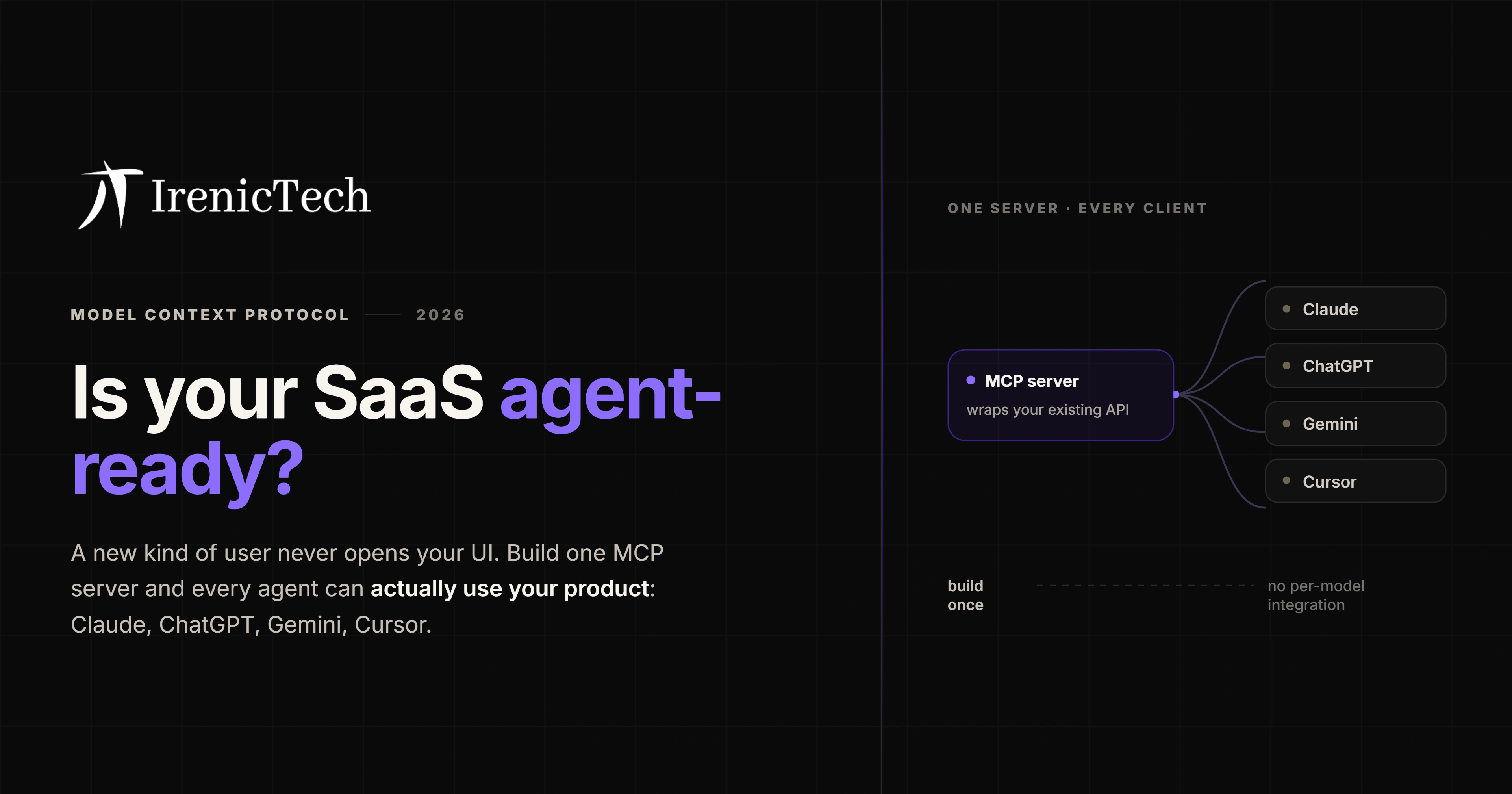
The Model Context Protocol has become the default answer, and the reason is economic rather than technical. Before it, every agent integration was bespoke: work that did not transfer between models or frameworks, and that had to be redone as the ecosystem moved. With it, you write one server exposing your tools, data and prompts in a standard shape, and any compatible agent can drive your product.
For a vendor that is the difference between being integrable once and being integrable repeatedly.
The protocol itself, and the governance it demands, is covered in MCP explained. The commercial argument specifically for SaaS vendors is in is your SaaS agent-ready.
One point worth pulling forward, because it is the one teams skip: the connection is the easy part. Standing up an MCP server over an existing API is not the hard work. Deciding what an agent may do unsupervised, what it must ask about first, and how you will reconstruct what it did, is the hard work.
Agent access is a permission problem
An API key carries an assumption: a developer read the documentation, made deliberate choices, and will notice if something goes wrong.
An agent makes no such guarantees. It may call the wrong endpoint confidently, retry harder than a person would, chain operations nobody anticipated, and act on content that a third party wrote into a field somewhere. None of that is misbehaviour. It is the normal operation of a system whose control flow is decided at runtime.
So agent access needs a different shape from ordinary integration access:
Scoping tighter than a typical integration key. Not what the customer can do, but what this agent is for.
Rate limits sized for machines. Whatever you set assuming human pacing is wrong by an order of magnitude.
Approval gates on the irreversible. Deleting, paying, sending externally, changing permissions. The gate costs latency and buys you survivability.
Logs that reconstruct a sequence. Not just which endpoint was called, but with what and why. An incident you can only describe is an incident you cannot close.
If you want to see that shape in a delivered system, the multi-tenant WhatsApp teardown publishes a build where tenant identity becomes a filter applied to every downstream query rather than a branch somebody has to remember, which is the structural version of this idea.
What breaks first
Multi-tenancy, almost always.
Anywhere a tenant or user identifier is taken from the request rather than from the authenticated session, you have a latent cross-tenant bug. With human users it can sit undiscovered for years, because people do not systematically probe parameters and most never think to. An agent iterating quickly through operations finds it far sooner, and when it surfaces it is not a bug report. It is a data-isolation incident with disclosure obligations attached.
We wrote up how that flaw gets introduced and what it costs in the costly oversight in multi-tenant SaaS architecture. If you read one thing before opening your product to agents, make it that.
The second thing to break is rate limiting, for the reason above. The third is usually an assumption that some field is always populated because the UI always populates it.
Building AI-native rather than AI-added
There is a difference between a product that uses AI and a product designed around it, and it becomes visible at exactly one moment: the first serious enterprise review.
An AI feature bolted onto an existing architecture tends to fail that review on the questions nobody prepared for. Where does the data go, which model processes it, can the customer opt a tenant out, what is logged, who can see the prompts, what happens when the model is wrong. Those are answerable by design or not at all, and retrofitting them is a rewrite.
Vertical AI-native SaaS specifically, and what survives that first enterprise deal, is covered in AI-native vertical SaaS.
The related strategic question, whether a given capability should be built at all or bought from someone who already has it, is worked through in build vs buy AI. The short version is the same as everywhere: if it touches what makes you competitive, build it, and otherwise do not.
The agent-readiness checklist
Concrete, in the order we would work through it.
Data
Can a structured query answer the questions a customer's agent would ask, without a person interpreting a page?
Are the fields that matter actually populated across the whole corpus, or only on the records someone curated?
Do your identifiers mean the same thing everywhere, so an agent joining two responses gets a correct result rather than a plausible one?
Interface
Is there a way to drive your product that does not involve scraping your UI?
Does your API expose the operations a customer would actually want automated, or only the ones that were convenient to build?
Is there an MCP server, and does it expose a deliberately chosen subset rather than everything you have?
Permissions
Can you issue a credential scoped to one agent, one customer and one purpose?
Which operations require a human, and is that enforced server-side rather than in a client?
Can you revoke one agent's access without breaking the customer's other integrations?
Safety
Is every tenant identifier taken from the session rather than the request, everywhere, verified rather than assumed?
Are rate limits sized for machine callers?
Is content written by third parties into your fields treated as data when an agent reads it back, rather than as instruction?
Observability
Can you reconstruct, from logs alone, the full sequence an agent performed last month and why?
Do you know which of your customers are already driving you through an agent? Most vendors do not, and the answer is rarely zero.
The rest of the cluster
Protocol and integration
- MCP explained: the protocol that makes agents useful
- Is your SaaS agent-ready?
- AI agents are buying things now
Architecture
Strategy
Where we come in
Taking a product with a decent API and turning it into something an agent can drive safely, in weeks rather than quarters, is the everyday work of our SaaS Platforms and AI Native practices. So is the less glamorous half: finding the tenant-isolation flaw before an agent does.
If you are not sure whether your product is ready for that shift, tell us what you have built and book a discovery call. We will map the shortest route from the API you have today to something an agent can actually use.
Frequently asked
What does agent-ready mean for a SaaS product?
It means an AI agent acting for a customer can discover what your product does, query its data in a structured way, take the actions your product offers, and do all of that under credentials scoped to that customer. In practice it rests on three things: a data model that is queryable rather than only renderable, an interface an agent can use without scraping your UI, and a permission system that can express what an agent specifically is allowed to do. Most products have some of the first, a partial version of the second, and almost none of the third.
Why does MCP matter for SaaS companies?
The Model Context Protocol standardises how tools, data and prompts are exposed to an AI agent. Before it, every agent integration was bespoke, so the work did not transfer between models or frameworks and had to be redone as the ecosystem moved. With it, you write one server and any compatible agent can drive your product. For a SaaS vendor that is the difference between being integrable once and being integrable repeatedly, and increasingly it is the difference between appearing in an agent-mediated workflow and being invisible to it.
Is agent-readiness actually urgent or is it hype?
The structured-data work is urgent and low-regret; the protocol integration can follow. Clean, complete, machine-readable data improves your ordinary search visibility, your feed quality, your ability to be surfaced by AI assistants and your own analytics, whether or not agents ever drive your product directly. That is worth doing regardless. The deeper protocol work is worth pacing against whether you actually see agent traffic, though platform vendors are increasingly shipping it for you, which moves the date closer than most roadmaps assume.
How is agent access different from normal API access?
An API key assumes a developer read the documentation, made deliberate choices and will notice if something goes wrong. An agent makes no such guarantees: it may call the wrong endpoint confidently, retry aggressively, chain operations nobody anticipated, and act on content a third party wrote. So agent access needs tighter scoping than a typical integration key, rate limits that assume machine-speed usage, approval gates on anything irreversible, and logging detailed enough to reconstruct a sequence of decisions after the fact.
What breaks first when agents start using a SaaS product?
Multi-tenancy, usually. Any place where a tenant or user identifier is taken from the request rather than from the authenticated session is a latent cross-tenant bug, and with human users it can sit undiscovered for years because people do not systematically probe parameters. An agent iterating quickly through operations finds it much faster, and the failure is a data-isolation incident rather than a bug report. The second thing to break is usually rate limiting, which was sized for human pacing.
What is agentic commerce and does it affect my product?
It is commerce where an agent performs some or all of the buying on a person's behalf, potentially without them ever visiting your site. Several open protocols now cover discovery, payment and authorisation, and major platforms have made agent access progressively more self-serve. It affects you directly if you sell online, and it affects you indirectly otherwise, because it is the clearest working example of the general pattern: the interface your customer uses may not be your interface, and what an agent can determine about your product decides whether you are in consideration at all.
Should a small SaaS company invest in this now?
Do the data work now, because it pays off independently of any agent ever calling you, and it is the prerequisite for everything else. After that, the sequencing question is whether your buyers are technical enough that an agent integration becomes a shortlist criterion, which in developer tools and infrastructure it already is, and in other categories is arriving at different speeds. The expensive mistake is not being late to MCP. It is having a data model that cannot support it when you decide to move.
Read us on Google
Make IrenicTech a preferred source.
Tell Google you want our work first. It takes one tap, and IrenicTech is favoured in your Top Stories, AI Mode, and AI Overviews whenever you search the topics we write about.
Add to preferred sources