AI Agent Development in 2026: From First Prototype to Production
Most writing about AI agents is either a demo or a warning. This is the working guide: what an agent is made of, how it reaches your systems through MCP, when one agent should become several, how much the model choice actually matters, why the majority never reach production, and what governance has to be in place before any of it is load-bearing. Every section links to the deeper piece on that question.
IrenicTech · · Updated · 16 min read
Most writing about AI agents is either a demo or a warning. The demo shows something impressive happening in ninety seconds. The warning explains why you should be frightened of it. Neither helps if your actual job is to decide whether an agent belongs in your product, and then to get one there without creating a mess you have to clean up later.
This is the working version. It covers what an agent is made of, how it reaches your systems, when one should become several, how much the model choice really matters, why most of them never ship, and what has to be true before any of it is load-bearing.
Each section links to the deeper piece on that question, so treat this as the map rather than the territory. If you would rather have one built than read about it, that is what our AI agent development services are for.
What an agent actually is
An agent is a system where a model decides what to do next, rather than only producing text.
You give it a goal, a set of tools it can call, and some memory to consult. It runs a loop: look at the state, choose an action, execute, observe what came back, decide again. It stops when the goal is met or when something you defined tells it to stop.
The distinguishing feature is not intelligence. It is agency over control flow. A chatbot answers a question and nothing in your business changes. An agent takes actions, and things change.
That single difference is where both the value and the risk come from. The agent can handle cases nobody wrote down in advance, which is the point. It also means you cannot enumerate in advance everything it will do, which is why the engineering around it matters more than the engineering inside it.
We went deeper on the definitional ground in what is agentic AI development, including where the term came from and how much of its current usage is marketing.
The four parts
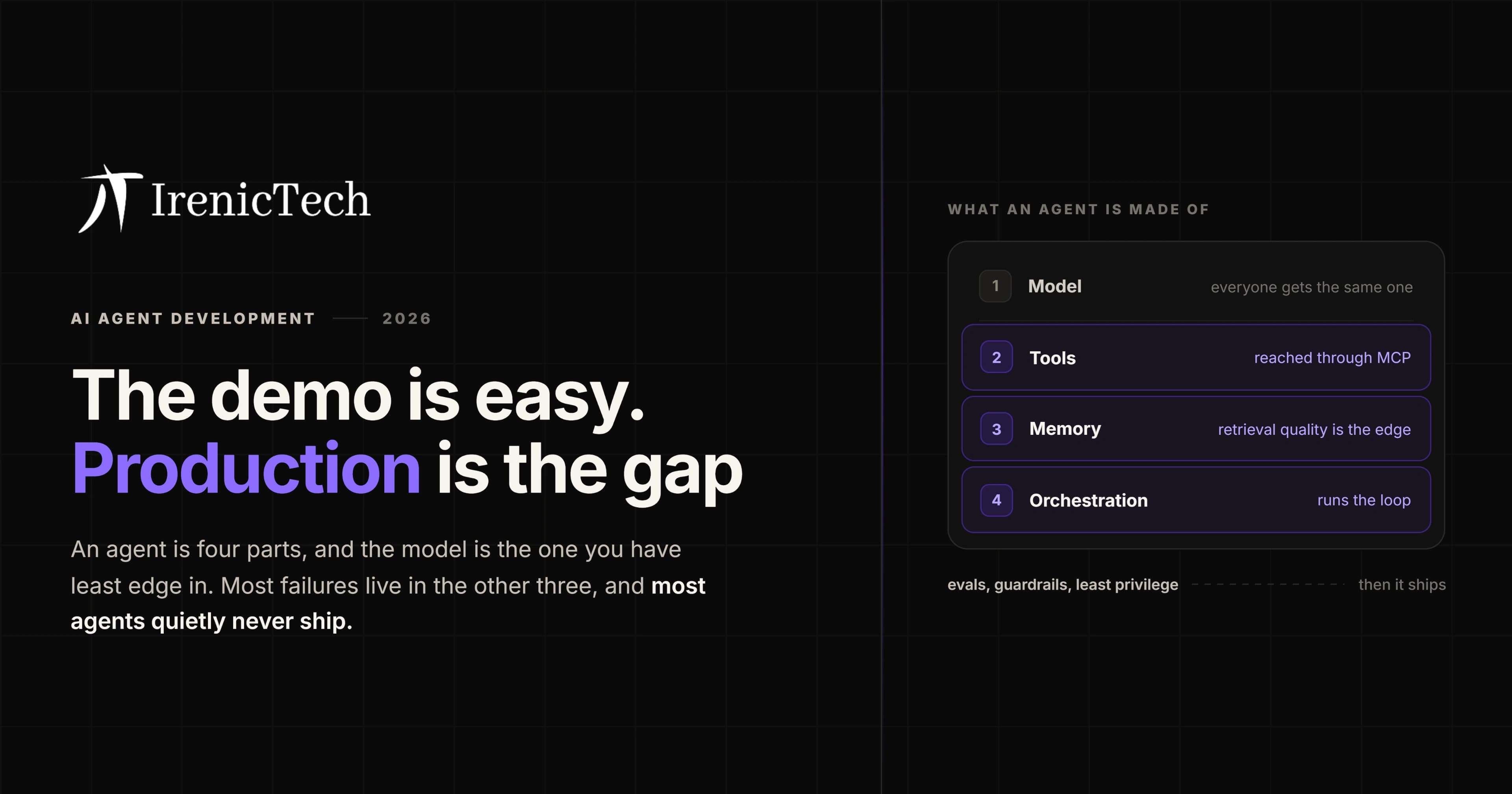
Almost every agent worth running is the same four components in some arrangement.
The model decides. It reads the state and picks the next action.
Tools are what it can actually do: query a database, call an API, send a message, write a file. An agent with no tools is a chatbot with extra steps.
Memory is what it can consult: retrieved documents, conversation history, prior decisions, structured records. Retrieval quality is usually the single largest lever on output quality, and it is almost always underinvested in relative to prompt engineering.
Orchestration runs the loop, enforces the limits, handles failure, retries, logs, and decides when to stop.
Here is the part that surprises people: in our experience, the overwhelming majority of agent failures live in the last three, not the first. Teams spend weeks on model selection and prompt wording, then lose to a retrieval layer returning the wrong three documents, or to an orchestration layer with no idea what to do when a tool times out.
How agents reach your systems
An agent that cannot touch anything is a demo. The connection layer is where it becomes useful, and where it becomes dangerous.
The Model Context Protocol has become the default answer to that connection problem. Instead of writing a bespoke integration for every agent and every framework, you write one MCP server exposing your tools, data and prompts in a standard shape, and any compatible agent can drive it. The work stops being throwaway.
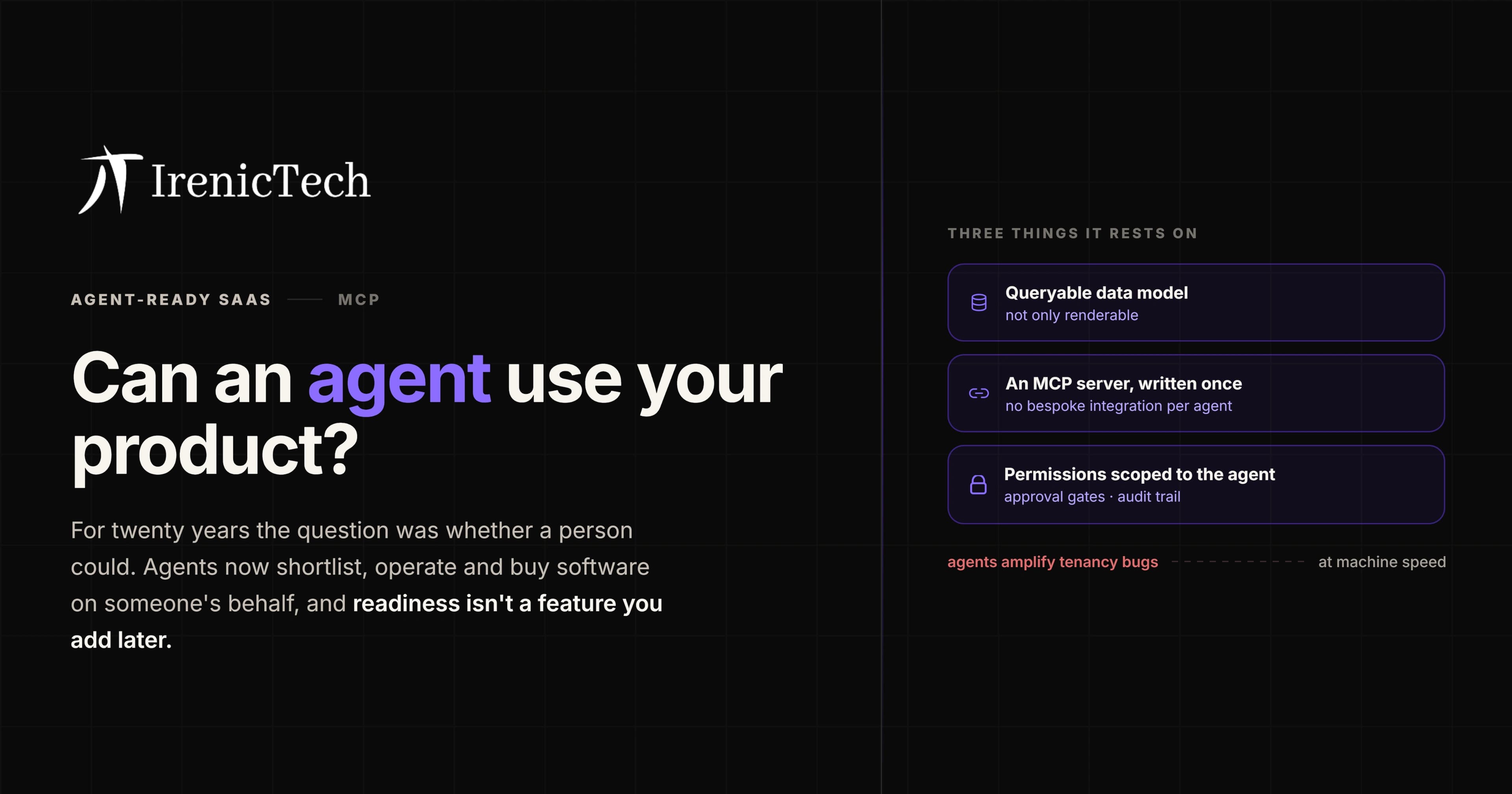
We covered the protocol itself, and the governance it demands, in MCP explained. If you sell software rather than only use it, the more pointed question is whether your own product can be driven by someone else's agent, which is the subject of is your SaaS agent-ready.
The short version of the governance point, because it is the part that gets skipped: the connection is the easy part. Wiring an agent into your systems is an afternoon. Deciding what it is allowed to do, what it must ask about first, and how you will know what it did, is the actual work.
One agent, or several
The honest answer for most teams is one.
A single well-scoped agent doing one useful job is easier to evaluate, easier to debug, easier to secure, and delivers most of the available value. Multi-agent architectures earn their complexity in a narrower set of cases: when a task is genuinely too large or too varied for one agent's context and instructions, and when you can state each agent's role and each handoff clearly.
The test we use is blunt. If you cannot write down what each agent is responsible for in one sentence each, you do not have a multi-agent system. You have one agent and a confusing prompt.
When you do cross that line, the build is mostly orchestration and guardrails rather than intelligence, which is covered in multi-agent systems.
There is a related pattern worth stealing even in a single-agent build: separate extraction from validation. In one delivered system of ours, inbound messages pass through two agents in sequence, the first extracting structured fields and the second validating and cleaning what the first produced, before anything is written. The failure modes genuinely differ. An extraction agent told to also be careful becomes reluctant to extract, and a single agent doing both has no second opinion on its own output. The full build is published as the multi-tenant WhatsApp teardown.
The model matters less than you think
This is the least popular thing in this guide and the most reliably true.
The base model is the component you have the least control over and the least edge in. Everyone gets the new one on the same day you do. Your retrieval quality, your data, the evaluation suite you run before trusting an output: those are yours, and they are what separate two teams using an identical model.
So the practical advice is architectural rather than comparative. Build so the model is a swappable part. Put it behind a boundary with its own eval suite, and when something better lands you run it against your own tests and decide in an afternoon instead of rewriting the application. We made that case when Claude Fable 5 launched, and the reasoning holds for every release since.
When you do need to choose, start from the job rather than the rankings: what it must do, what your licence and data-residency constraints are, and where it has to run. That narrows things fast. The open-versus-closed question specifically is covered in should you use open-source LLMs, and the current field in the best open-source LLMs in 2026.
Not every decision should be a model call
A pattern worth naming, because it is about to become a common and expensive mistake.
When teams get excited about agents, they start routing decisions through a model that were never judgment calls. A numeric threshold. An exact match on an email address. A status lookup. A checksum comparison. These are rules. They execute in under a millisecond, cost nothing, never drift, and any auditor can read them.
Putting a probabilistic model behind a rule makes it slower, more expensive and less predictable in exchange for nothing.
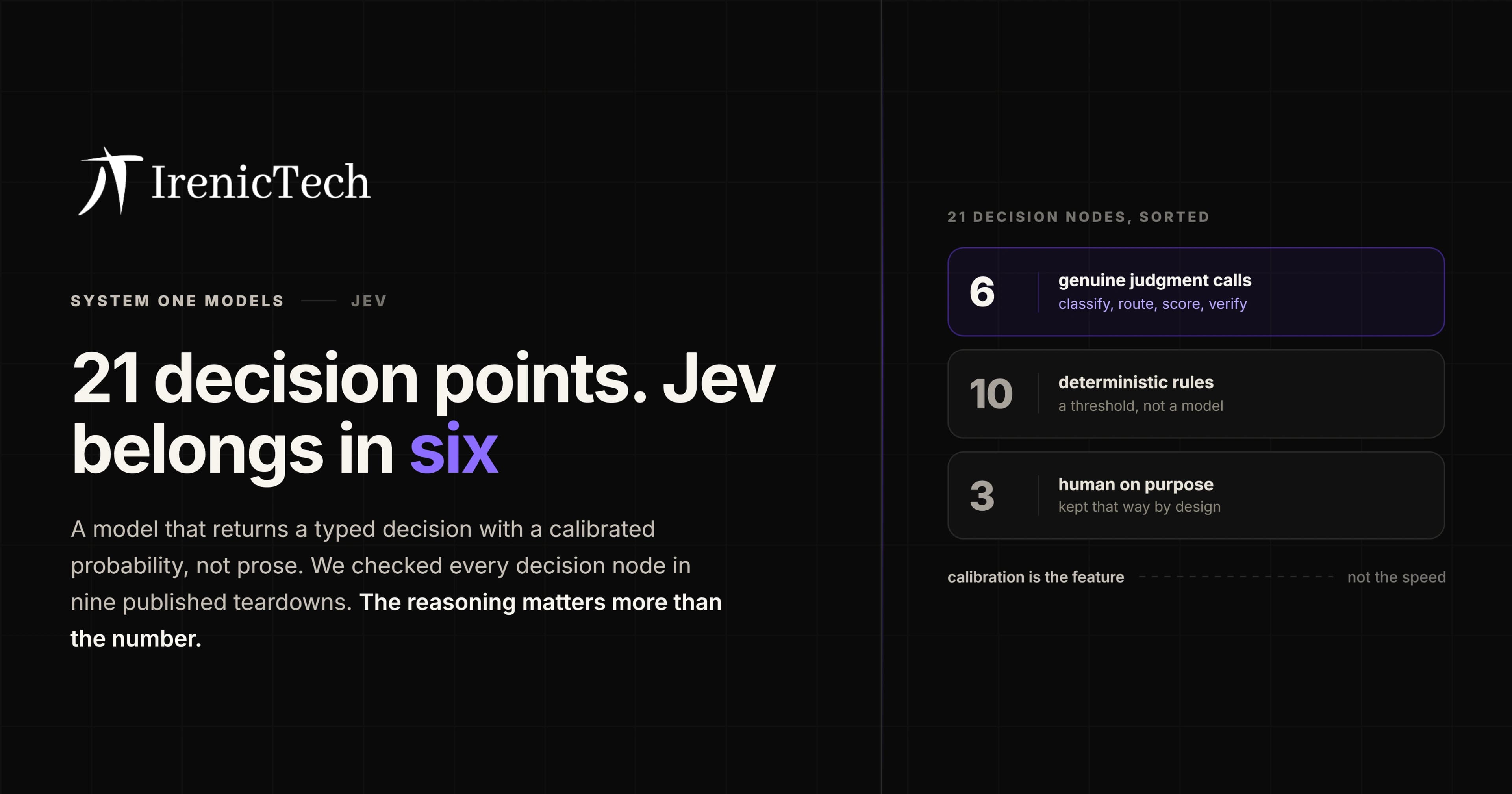
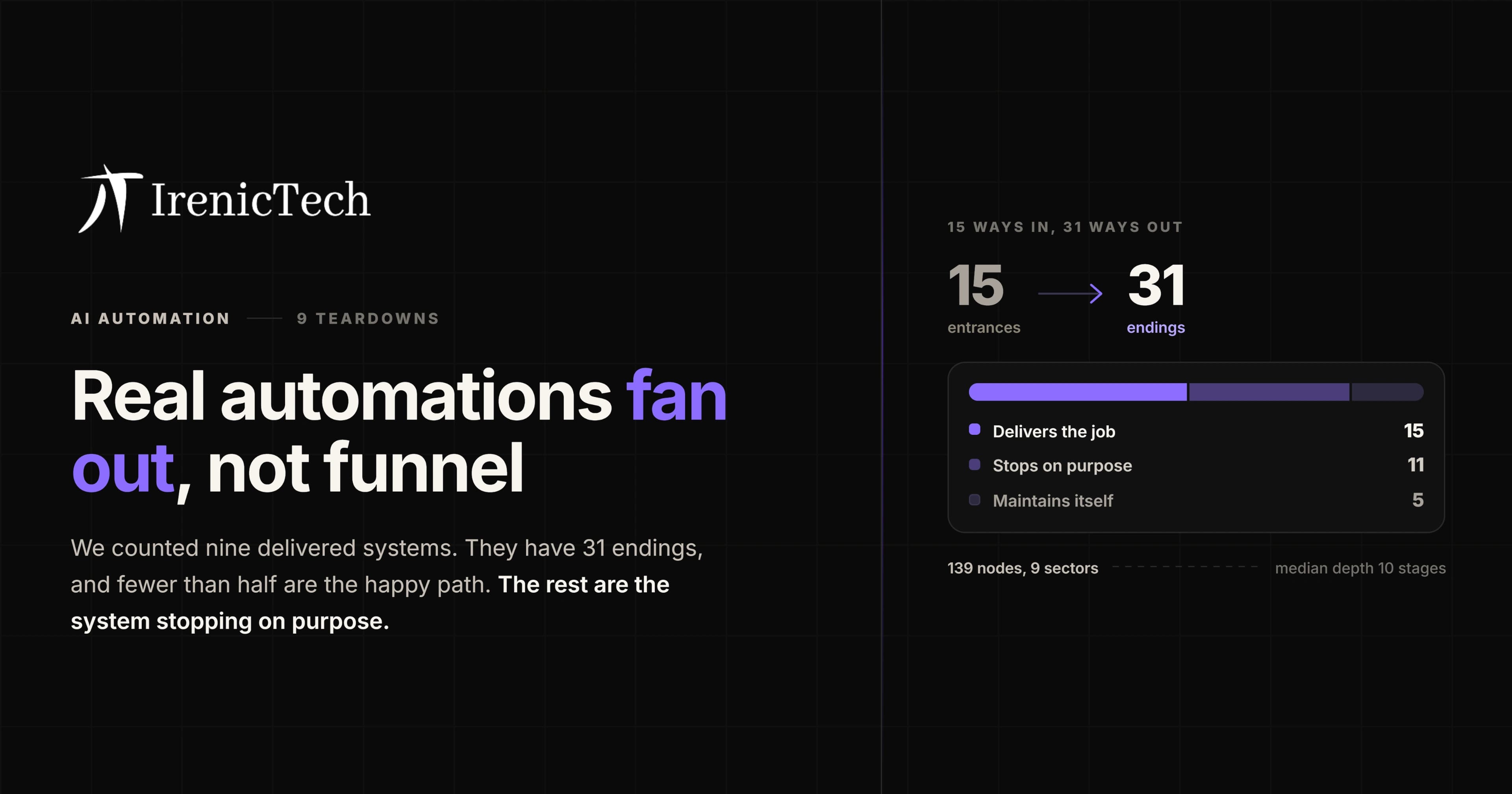
We went through the nine automation systems we publish as full teardowns and counted the decision points. Most of them are not model-shaped at all, and several are deliberately human. The skill worth developing is telling the difference between a branch that is a judgment and a branch that is a rule, before you build either one.
Why most agents never reach production
A demo and a product fail in different ways.
A demo has to work once, on an example you chose, in front of a forgiving audience. A product has to work on inputs nobody anticipated, be debuggable when it does not, be safe when it is wrong, and stay affordable at volume.
The work that closes that gap is unglamorous, and it is the same list every time: an evaluation set built from real cases, guardrails on what the agent can do unsupervised, least-privilege access, observability into what was called and why, and a feedback loop that turns real usage into improvements.
Teams that build those before adding capability tend to ship. Teams that add capability first tend to stall at an impressive pilot that never quite becomes a product. We wrote that up in detail in most AI agents never reach production.
There is a measured version of this gap in the developer data too. Engineers now use AI for a large share of their work while being able to delegate almost none of it unsupervised, and the distance between those two numbers is the whole engineering problem, which is the subject of the agentic AI trust gap.
What an evaluation set actually looks like
Every section above leans on the word evals, so it is worth being concrete, because the vague version is why teams skip it.
An evaluation set is a fixed collection of real inputs paired with what a good response would be, that you run the whole system against on every meaningful change. Not a benchmark. Not a score out of ten from another model. Your cases, from your domain.
Building the first one takes about a day and goes roughly like this.
Collect thirty real cases. Pull them from support tickets, logs, old emails, whatever the agent will actually see. Thirty is enough to be useful and few enough that you will actually do it. Resist the urge to write synthetic examples, because synthetic cases test the system you imagined rather than the one people will use.
Include the ugly ones deliberately. The half-finished sentence. The request in the wrong language. The message with three questions in it. The one where the right answer is to refuse or escalate. A set made only of clean cases will pass forever and tell you nothing.
Write down what good looks like for each. Sometimes that is an exact value, which is easy to check automatically. More often it is a set of conditions: the answer must cite a real document, must not invent a policy, must route to the right team. Conditions you can check in code are worth more than prose you have to read.
Run it on every change. New prompt, new model, new retrieval strategy, new tool. If the number moves, you know why. This is the part that turns model upgrades from a rewrite into an afternoon.
Add every production failure to the set. When the agent gets something wrong in real use, that case becomes a permanent test. Over a few months this is what makes the set genuinely yours and genuinely hard for a competitor to replicate.
The reason this matters more than it sounds: without an eval set, every decision about the agent is an argument about vibes, and the loudest person wins. With one, disagreements resolve in minutes. That change in how a team makes decisions is worth more than most of the engineering around it.
Guardrails are the runtime half of the same discipline. An eval set tells you what the system does on cases you have seen. Guardrails decide what it is permitted to do on the ones you have not: the action it must ask before taking, the spend it cannot exceed, the output shape it must conform to, the tool it cannot call without a human. Build both before adding capability, not after the pilot impresses somebody.
Security is the part that gets rushed
The pattern we keep seeing is a team rushing an agent into production for the productivity win, then discovering the security bill later, usually at the worst possible moment.
The governance has to be designed in at the first connection, not retrofitted once the agent is load-bearing. In practice that means credentials scoped to exactly what the agent needs and nothing adjacent, human approval on anything irreversible or high-value, full logging of calls and reasons, validation of the agent's output before it reaches a database or an external system, and treating any text the agent ingests as untrusted input rather than as instructions.
That last one is the subtle one and it is where prompt injection lives. Content your agent reads is data. It is never a command, no matter how confidently it is phrased.
The full treatment is in agentic AI security. If the code itself was largely AI-written, which is now common, there is a second and distinct problem covered in your AI wrote the code, who is securing it.
For a worked example of an agent held inside a hard boundary, the voice compliance system answers strictly from approved documentation or states that it cannot answer, which is a design decision rather than a model capability.
Your codebase is part of the agent
If agents are going to work inside your repository, the repository is now part of the system's reliability.
Agents do not fix broken engineering practices. They scale them. A codebase without tests, without clear module boundaries, without a real review process, gets worse faster once agents are committing to it, because the rate of change goes up and the quality of the guardrails does not. That argument is made properly in agents do not fix broken engineering practices.
If you are still selecting the tooling itself, we compared the current options in AI coding agents in 2026.
Build or buy
Not every agent should be built.
The question that resolves most cases is whether the use case touches what makes you competitive. If it does not, buy the best tool available and stop thinking about it. If it does, you are looking at a build, and the next question is whether it is a full custom system or a lean layer over tools you already pay for. That decision tree is laid out in build vs buy AI.
How we actually ship them
Our own method is deliberately narrow: pick one genuinely useful slice, build the evaluations and guardrails before adding capability, wire in the feedback loop, and get it in front of real users early enough that reality can still change the design. It is described in how we ship AI-native products in weeks.
The reason we publish full architecture teardowns of delivered systems, every intake path and every branch with the condition that fires it, is that the decision logic is the part worth showing. A screenshot proves nothing. A branch table proves you thought about the cases.
That work is the substance of our AI Native and AI automation practices.
How much does AI agent development cost?
There is no honest number without the job in front of you, because the cost is decided by a handful of things that vary enormously between projects. These are the ones that move it most:
- How many workflows are in scope. One agent on one job is a different project from agents working across several systems.
- What it has to connect to. An existing, documented API is quick. A system with no API, or with messy data behind it, is where budgets go.
- How much it may do alone. The more an agent can do without a person, the more evaluation, guardrails and approval logic it needs.
- The data it reads. Retrieval is only as good as its sources, so cleaning and structuring them is often real work.
- Your compliance obligations. HIPAA, SOC 2 or a regulator's audit trail add requirements to access, logging and hosting.
- The channel. A voice agent has telephony, latency and fallback paths that a text agent does not.
- The cost of running it. Model usage at real volume is a line item, and it should be estimated before launch rather than discovered after it.
We scope productized sprints at a fixed price, and quote a full platform after discovery. The more useful early question is which single workflow is worth doing properly first, since that answer usually changes the budget more than any implementation choice does.
The AI agent development process
The order matters more than the tools. This is the sequence from discovery to production:
- Choose the workflow. One job where an agent removes real friction, where you can tell afterward whether it worked, and where being wrong is recoverable.
- Write down what good looks like. Real cases and their right answers become the evaluation set, before there is an agent to test.
- Map the tools and permissions. What it can call, with which credentials, and what needs a person to approve it.
- Build the narrow slice. One path working end to end, with logging from the first version.
- Add the guardrails. Output validation, approval gates on irreversible actions, and a defined fallback when it does not know.
- Test on real inputs. The cases nobody anticipated are the ones that matter, so run the evaluation on every change.
- Ship to a small group. Early enough that what happens can still change the design.
- Close the loop. Real usage feeds the evaluation set, and only then does the scope widen.
How long it takes
A narrow agent on one workflow with an existing API is a matter of weeks. A platform where agents operate across several systems, with real compliance obligations, is a different order of work.
The things that stretch a timeline are rarely the model. They are getting access to the systems, assembling real cases to evaluate against, and waiting on decisions about what the agent is allowed to do. Sort those out early and the build itself tends to be the predictable part.
What to put in an AI agent development proposal
Whether you are writing one or reading one, a proposal worth signing answers these:
- The workflow and its owner. Which job, and who in your business is accountable for it.
- How success is measured. The evaluation set, and the score that means it is ready.
- Tools and permissions. Every system it touches, and the access it gets on each.
- What it does unsupervised. And which actions need a person to approve them.
- What happens when it is wrong. The fallback, the escalation path and how a mistake gets reversed.
- Data handling. What it reads, what it stores, where that lives and for how long.
- The model boundary. Which model, why, and how you would swap it later.
- Logging and observability. How you will see what was called and why.
- Handover. Who owns the code, the evals and the runbooks at the end.
- Running costs. An estimate of model and hosting costs at realistic volume.
- What is out of scope. So nobody discovers it at the end.
If a proposal cannot answer most of this, the vendor has probably not shipped one to production yet. For the definitions behind these terms, see what is agentic AI development.
The rest of the cluster
Everything referenced above, in reading order.
Foundations
- What is agentic AI development in 2026
- MCP explained: the protocol that makes agents useful
- Multi-agent systems
Getting to production
- Most AI agents never reach production
- How we ship AI-native products in weeks
- The agentic AI trust gap
Choosing the pieces
- Build vs buy AI
- Should you use open-source LLMs for your product
- The best open-source LLMs in 2026
- Claude Fable 5
Security and engineering practice
- Agentic AI security
- Your AI wrote the code, who is securing it
- Agents do not fix broken engineering practices
- AI coding agents compared in 2026
If you build software other people integrate with
Where to start
If you are at the beginning of this, the useful first move is not choosing a framework or a model. It is choosing the workflow.
Pick the one job where an agent would remove real friction, where you can tell afterwards whether it worked, and where being wrong is recoverable. Build the evaluation for it before you build the agent. Then ship that one slice to real users and let what happens next inform everything else.
If you want a straight answer on which workflow that should be for your business, tell us what you are running and book a discovery call. Our AI agent development services page covers how an engagement runs.
Frequently asked
What is an AI agent?
An AI agent is a system where a language model decides what to do next rather than just producing text. It is given a goal, a set of tools it can call, and some memory to consult, and it runs a loop: consider the state, pick an action, execute it, observe the result, repeat until the goal is met or a stopping condition fires. The distinguishing feature is not intelligence but agency over control flow. A chatbot answers; an agent acts, and something in your business changes as a result.
How is an AI agent different from a chatbot or an automation?
A chatbot returns text to a person and nothing else happens. A traditional automation follows a path someone drew in advance, so every branch is known before it runs. An agent sits between them: the path is decided at runtime by a model, within limits you set. That flexibility is the whole value and the whole risk. It means the agent can handle cases nobody enumerated, and it means you cannot fully enumerate what it will do, which is why governance and evaluation matter more here than in either of the other two.
What is MCP and why do agents need it?
The Model Context Protocol is an open standard for exposing tools, data and prompts to an AI agent in a consistent way. Before it, every agent-to-system connection was a bespoke integration, which meant the work did not transfer between models or frameworks. MCP turns that into a server you write once and any compatible agent can drive. For a SaaS product it is increasingly the difference between being usable by an agent and being invisible to one, which matters as more software gets evaluated and operated by agents rather than only by people.
Do I need a multi-agent system?
Almost certainly not yet. Most real value still comes from one well-scoped agent doing one useful job, and a single agent is dramatically easier to evaluate, debug and secure. Multi-agent setups earn their complexity when a task is genuinely too large or too varied for one agent's context and instructions, and when you can state each agent's role and handoff clearly. If you cannot write down what each agent is responsible for in a sentence, you do not have a multi-agent architecture, you have one agent with a confusing prompt.
Which model should I use to build an agent?
Start from the job rather than the leaderboard: what does it actually need to do, what are the licence and data-residency constraints, and where will it run. That usually narrows the field to two or three candidates quickly, and then you test those on your real task with your real data. Build the system so the model sits behind a boundary with its own eval suite, because a better model will land within months and you want that to be an afternoon's work rather than a rewrite.
Why do most AI agents never reach production?
Because a demo and a product fail in different ways. A demo has to work once, on a chosen example, with a forgiving audience. A product has to work on the inputs nobody anticipated, be debuggable when it does not, be safe when it is wrong, and be affordable at volume. The work that closes that gap is unglamorous: evaluation sets, guardrails, least-privilege access, observability and a feedback loop from real use. Teams that build those before adding capability tend to ship. Teams that add capability first tend to stall.
What does it cost to build an AI agent?
It varies with scope, and anyone quoting a figure before understanding the job is guessing. A narrow agent on one workflow with an existing API is a matter of weeks. A platform where agents operate across several systems with real compliance obligations is a different order of work. The more useful early question is which single workflow is worth doing properly first, because that answer usually changes the budget more than any implementation choice does.
How do you keep an AI agent secure?
Design the governance in at the first connection rather than retrofitting it after the agent is load-bearing. In practice that means least-privilege credentials scoped to exactly what the agent needs, human approval gates on any irreversible or high-value action, full logging of what was called and why, validation of the agent's output before it reaches a database or an external system, and treating any text the agent ingests as untrusted input rather than as instructions.
Read us on Google
Make IrenicTech a preferred source.
Tell Google you want our work first. It takes one tap, and IrenicTech is favoured in your Top Stories, AI Mode, and AI Overviews whenever you search the topics we write about.
Add to preferred sources