The ASOS Breach: How One Tricked Employee Opened the Customer Data
In October 2026, ASOS customers got a push notification from the ASOS app saying the company had been hacked. ASOS says it started with one employee tricked into handing over a login. No malware, no software flaw. Here is how that kind of attack works, and the handful of controls that stop it at a company of any size.
IrenicTech · · 6 min read
On 6 October 2026, people with the ASOS app on their phones got a notification that did not come from ASOS's marketing team. It said the company had been hacked, and it told ASOS staff to get in touch with the attackers on Telegram.
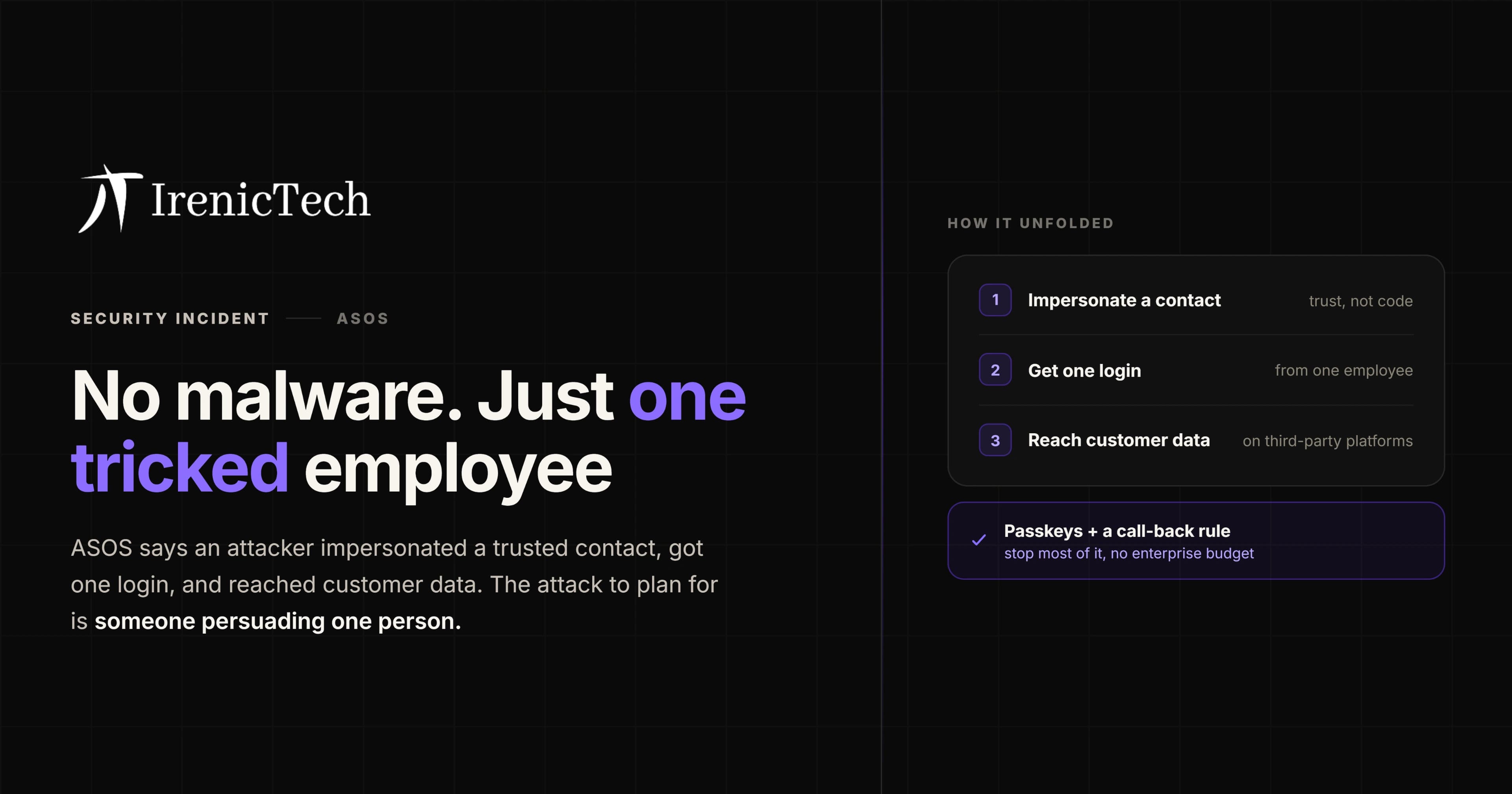
ASOS confirmed a breach within hours. Its explanation of how it happened is the part every business owner should read twice. An attacker, ASOS says, gained access to an employee account "by impersonating a trusted contact to obtain log in credentials," and then used those credentials to reach information on third-party platforms ASOS uses.
No malware. No software vulnerability anyone has identified. One person, persuaded to hand over a login.
What ASOS and the reporting say happened
Here is what has been confirmed or credibly reported, as of 27 October 2026. The investigation is ongoing.
- The way in. Someone impersonated a contact the employee trusted and got their login credentials. ASOS has not said how the impersonation was done or whether multi-factor authentication was involved.
- What was reached. With that login, the attacker got into information held on outside platforms ASOS uses. The attackers first said Snowflake, then told the BBC they got in through Simon AI, a personalisation platform built on Snowflake. Snowflake says it found no compromise of its platform. A stolen login used to sign in normally is not the same as the platform being hacked.
- What was taken. ASOS describes it as basic personal information: names, contact details and some non-personal account data. A sample the attackers gave the BBC, reported by Malwarebytes, also showed home addresses, phone numbers, dates of birth, customer numbers, when each customer joined, and searches people made on the site. ASOS says payment cards and passwords were not accessed, and has not said how many customers were affected.
- The calling card. The attackers, calling themselves Xuanye Group, used their access to send that push notification through the ASOS app, and reportedly demanded a ransom to delete the data.
- The response. ASOS locked down the affected platforms, brought in outside specialists, involved law enforcement and regulators, and says it has strengthened its security controls.
Why this is the attack that matters for your business
It is tempting to file this under "big retailer problem". It is the opposite. This is the attack that scales down perfectly.
It needs no technical skill against you. The attacker did not have to find a flaw in ASOS's systems. They needed one convincing conversation. Your business has people, and people can be convinced.
It goes straight to the outside platforms. Customer data rarely lives in one place now. It sits in your CRM, your email marketing tool, your analytics, your helpdesk, your ecommerce platform, your personalisation tool. Each one has its own login, and each one is a place a stolen password can open, often without anyone checking.
A valid login looks like work. Once the attacker signs in with real credentials, the platform sees an employee doing their job. This is the same shift we wrote about in why attackers log in instead of breaking in: most intrusions now use credentials that work rather than malware.
Your customers become the next target. Stolen names, addresses and shopping searches are the raw material for convincing phishing. "Your refund for the Reclaimed Vintage jacket is ready" is a far better scam than a generic one. When your customer data leaks, the damage does not stop at your systems.
The three controls that stop most of this
You do not need a security operations centre. You need a few unglamorous decisions, made once and enforced.
1. Sign-in that cannot be phished
Passwords can be handed over. So can six-digit codes from an app or a text message, and so can "approve this login?" prompts, which attackers trigger repeatedly until someone taps yes. Passkeys and hardware security keys are different. They only work on the real website they were registered on, so there is nothing to read out to a caller and nothing that works on a fake page.
Start with the accounts that would hurt most: email, your cloud and domain accounts, finance, and every platform that holds customer data. Google Workspace, Microsoft 365 and most major business tools support passkeys today.
2. A call-back rule with no exceptions
Write one rule down and tell everyone, including yourself: nobody shares a password or code, approves a login, or resets an account because of a message or call alone. If a request involves access, you end the conversation and contact the person on a number or channel you already have. Not the one in the message.
It sounds basic. It is also exactly the step that stops "impersonating a trusted contact". Attackers count on urgency and politeness. A rule removes the awkwardness of saying no to someone who sounds like your manager or your IT provider.
The same rule applies to whoever runs your IT. Helpdesk password resets are one of the most common ways in, so make sure your provider verifies identity properly before resetting anything.
3. Know where your customer data lives, and who can reach it
Make a list of every outside platform that holds customer data. For each: who has a login, whether they still need it, whether sign-in goes through your main company account (single sign-on), and whether anyone would notice an unusual export.
Most small businesses that do this find accounts belonging to people who left, shared logins nobody owns, and tools someone trialled two years ago that still hold a copy of the customer list. Removing those is free. It also means a stolen login reaches less.
If someone does get tricked
Assume it will happen eventually, and make it easy to own up fast. The employee who says "I think I just gave my password to someone" within five minutes is your best defence; the one who stays quiet out of embarrassment is your worst. Have a short plan:
- Reset the password and sign the account out everywhere.
- Check what it accessed recently, especially exports and admin changes.
- Revoke any new devices, app connections or forwarding rules the attacker may have added.
- Tell whoever needs to know, including customers and regulators if personal data was taken. The rules vary by country, and getting advice early is cheaper than getting it late.
Want help locking this down?
Access reviews, sign-in hardening and access logging across the platforms you already use are part of our security and compliance work. If you want to see what an attacker could actually reach with one stolen login, our VAPT service tests your web apps, APIs and cloud the way an attacker would, scores every finding with CVSS, retests for free once you have fixed it, and gives you a signed letter for clients and insurers.
Tell us which tools your team signs in to and book a discovery call. We will show you where one tricked employee could do the most damage, and how to close it.
For more on how attacks are changing, see where AI attackers went after phishing, and for what a stolen login can lead to at a small business, the Q3 2026 ransomware numbers.
Part of our guide to AI security.
Sources: BleepingComputer, "ASOS links data breach to social engineering attack, credential theft" (8 October 2026), quoting ASOS's security notice, and Malwarebytes' ASOS breach update (9 October 2026), reporting the BBC's sample of the stolen data and Snowflake's statement. Verified against these sources on 27 October 2026.
Frequently asked
What happened in the ASOS data breach?
On 6 October 2026, ASOS app users received a push notification claiming the company had been hacked and urging ASOS staff to contact the attackers on Telegram. ASOS then confirmed that an unauthorised party had gained access to an employee account by impersonating a trusted contact to obtain login credentials, and used them to access information on certain third-party platforms ASOS uses. ASOS says basic personal information such as names and contact details may have been exposed, and that payment card details and account passwords were not accessed. A group calling itself Xuanye Group claimed responsibility.
What data was taken in the ASOS breach?
ASOS described it as basic personal information, including full names and contact details, plus some non-personal account information. A sample the attackers shared with the BBC, reported by Malwarebytes, also included home addresses, phone numbers, email addresses, customer numbers, dates of birth, when each customer started using ASOS, and searches customers made on the site. ASOS says payment card information and customer passwords were not accessed. It has not said how many customers were affected.
Was Snowflake hacked in the ASOS breach?
No compromise of Snowflake has been established. The attackers first named Snowflake and later told the BBC they reached the data through Simon AI, a personalisation platform built on Snowflake that ASOS uses. Snowflake said it found no compromise of its platform. The pattern ASOS describes is stolen employee credentials being used to sign in to a legitimate service, which is not the same as the service itself being breached.
What is social engineering?
Social engineering is getting a person to do the attacker's work for them: hand over a password, read out a one-time code, approve a login prompt, reset an account, or install remote access software. The attacker usually poses as someone the target trusts, such as a colleague, a supplier, IT support or a manager. It works because it skips every technical control. A perfectly patched system still lets in someone with a valid password and an approved login.
How can a small business protect itself from this kind of attack?
Start with sign-in. Move the accounts that matter (email, cloud admin, finance, your CRM and any platform holding customer data) to passkeys or hardware security keys, which cannot be phished the way passwords and text-message codes can. Add a simple rule that nobody ever shares a password or code, or approves a reset, because of a message or call alone: they hang up and call back on a number they already know. Then list every outside platform that holds customer data, who can sign in to it, and whether that access is still needed. Those three steps close most of the doors this attack uses.
I am an ASOS customer. What should I do?
ASOS says no action is needed on customer accounts, because passwords and payment details were not accessed. The real risk is phishing that uses the stolen details to look convincing, for example a message about a refund or a delivery that mentions something you actually searched for. Do not click links in unexpected messages about ASOS; open the app or website directly instead. Do not contact the attackers, and never share a password, security code or card details with anyone who contacts you. ASOS says it will never ask for them.
Read us on Google
Make IrenicTech a preferred source.
Tell Google you want our work first. It takes one tap, and IrenicTech is favoured in your Top Stories, AI Mode, and AI Overviews whenever you search the topics we write about.
Add to preferred sources