How We Ship AI-Native Products in Weeks, Not Quarters
Why we scope AI like a product, build the feedback loop first, and ship secure AI in weeks instead of quarters.
IrenicTech · · 2 min read
Most teams know they need AI in their product. Few can build it so it actually ships, stays secure, and keeps working. That last part is the hard part.
Weeks, not quarters
We treat AI like a product, not a research project. Open-ended projects drift. Without a fixed thing to ship, scope creeps and "almost done" drags on for months.
So we pick one narrow, useful slice, build it into your existing product, and get it in front of real users in a few weeks. The rest of the roadmap waits. The first slice ships.
The part most teams skip: it has to learn
A static AI gives the same wrong answer forever, so people stop using it.
One client called their old tool "useless." It was right most of the time. But most of the time isn't good enough when someone's checking a medical protocol. They got one wrong answer, lost trust, and never opened it again. The tool wasn't broken. It just couldn't learn.
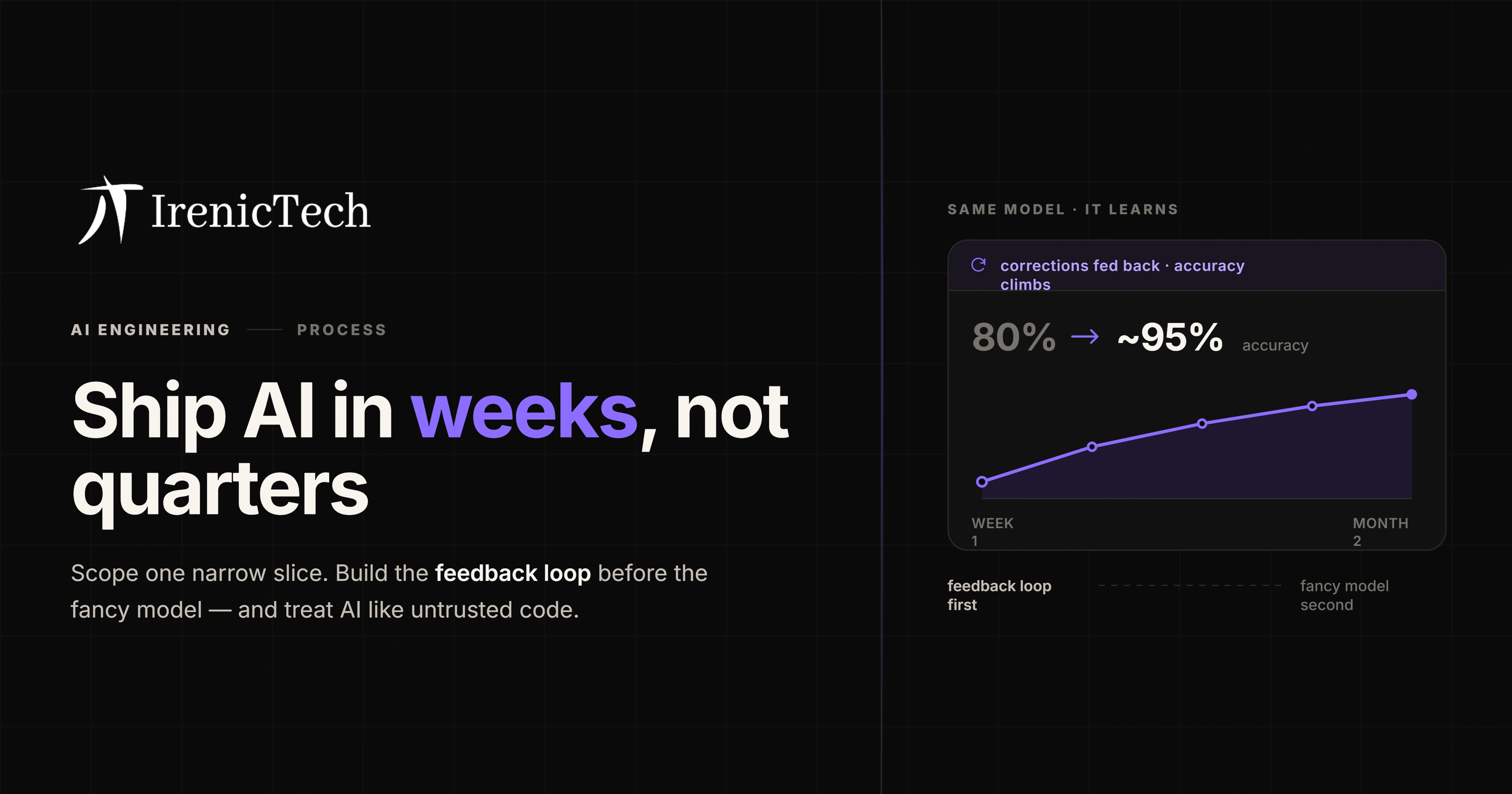
The fix wasn't a bigger model. We added the boring part nobody demos: a way to flag bad answers, and a pipeline that feeds those corrections back in. It started around 80% accurate. A couple of months later it was near 95%. Same model the whole time.
Feedback loop first, fancy model second. Most teams do it the other way around.
Secure by design
AI that touches your data shouldn't widen your attack surface, so we treat it like untrusted code. We isolate it so it can't reach what it shouldn't. We give it the least access the job needs and nothing more. And we monitor and allow-list what it can talk to.
That's how you get AI that saves work without becoming the weakest link in your stack. It's also why our builds are HIPAA, GDPR and SOC 2-ready.
Why it works
A slice that ships in weeks, learns from real use, and can be trusted with real data tells you something real. Real signal beats guesswork, and it takes the risk out of every decision that comes after.
That is the working method behind our AI Native practice, and it is the same reasoning we set out in what separates agents that reach production. IrenicBot and Unicare were both built this way. If you have a slice worth shipping, book a discovery call.
Part of our guide to AI agent development.
Frequently asked
How long does it take to ship an AI feature into our product?
We ship a first production release in weeks, not quarters. We pick one narrow, useful slice, build it into your existing product, and get it in front of real users. Then we build out from there.
Is the output production-ready or just a demo?
Production-ready. Evals, guardrails, observability and a correction feedback loop are part of the build, so what ships keeps working instead of getting abandoned after week one.
Is it safe to give AI access to our internal data and systems?
We treat AI like untrusted code: isolation, least privilege and monitored access. It reduces busywork without widening your attack surface, and builds are HIPAA, GDPR and SOC 2-ready.
Read us on Google
Make IrenicTech a preferred source.
Tell Google you want our work first. It takes one tap, and IrenicTech is favoured in your Top Stories, AI Mode, and AI Overviews whenever you search the topics we write about.
Add to preferred sources